

仮想通貨を持つならここを登録!【PR】

Important Notice & Disclaimer
This article has been prepared solely for objective informational and educational purposes regarding trends and data in the cryptoasset (cryptocurrency) market. It does not constitute a solicitation to buy or sell any specific cryptoassets or financial instruments, nor does it provide investment advice or recommend the use of unregistered service providers. Cryptoasset prices are subject to extreme volatility and carry the risk of capital loss. Any decisions regarding trading or investment should be made entirely at your own risk. Furthermore, the information contained herein is based on publicly available data and reports as of November 2026.
- 1 Introduction: The Reality Behind the 'Polarisation' in the 2026 Cryptoasset Market
- 2 1. The Reality of the 2026 Altcoin Market in Numbers: Performance Data for Major Tokens
- 3 2. Why Has Liquidity Drained from Altcoins? Four Structural Drivers
- 3.1 1. Institutional Capital Remains Trapped in 'BTC and ETH via ETFs'
- 3.2 2. Declining Retail Trading Activity and Capital Outflows to Other Markets
- 3.3 3. The Macroeconomic Environment and Concerns Over 'Higher-for-Longer' Interest Rates
- 3.4 4. Supply-Demand Deterioration Driven by Token Oversupply (Unlock Pressure)
- 4 3. A Shift in Valuation Metrics: From 'Market Cap and Narrative' to 'Fee Revenue and Fundamentals'
- 5 4. Structural Shifts Extending to Cryptocurrency Exchange Business Models
- 6 5. Five Key Risk Factors Market Participants Must Recognise (YMYL & Risk Awareness)
- 6.1 1. Liquidity Depletion Risk (Slippage and Amplified Flash Crashes)
- 6.2 2. Volatility (Price Fluctuation) and Principal Loss Risk
- 6.3 3. Smart Contract and Hacking Risk
- 6.4 4. Regulatory and Tax Reform Risk (Domestic Legislative Developments in Japan)
- 6.5 5. Project Obsolescence and Development Stagnation Risk
- 7 Conclusion: Reading the Data Calmly and Adapting to an Evolving Market Structure
Introduction: The Reality Behind the ‘Polarisation’ in the 2026 Cryptoasset Market
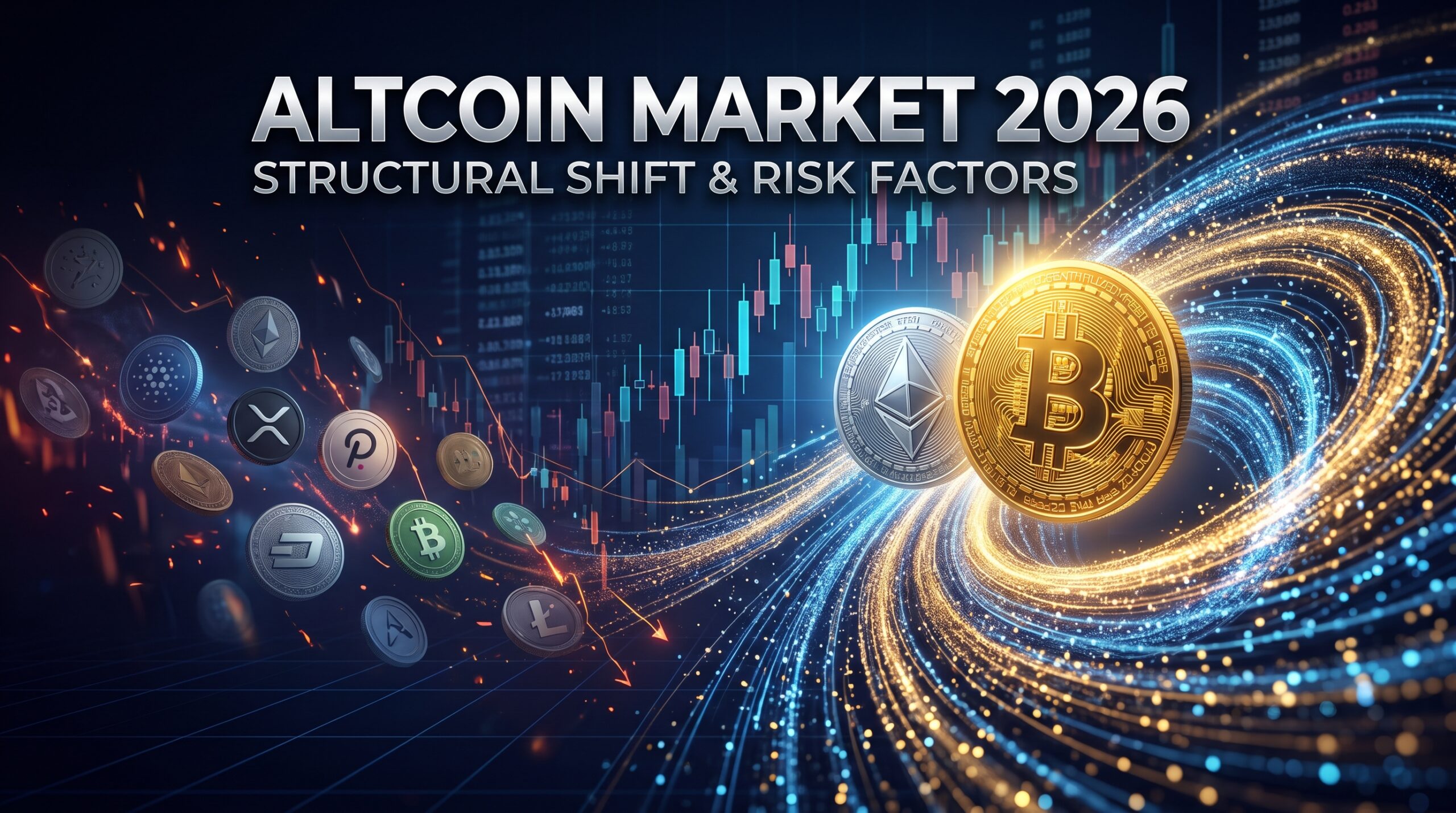
In 2026, the cryptoasset (cryptocurrency) market has reached a structural turning point that differs markedly from previous bull markets. Historically, market convention held that a rally in Bitcoin (BTC) would see profits flow into Ethereum (ETH), before eventually rotating into smaller-capitalisation altcoins and memecoins—a phenomenon widely known as ‘altcoin season’.
However, market data since the start of 2026 demonstrates that this historical rule of thumb is breaking down. While Bitcoin dominance (market share) has climbed towards the 62% level, the total market capitalisation of altcoins excluding Bitcoin and Ethereum fell by approximately 22.84% in the first half of 2026 alone. Across the year as a whole, roughly 60% of tracked tokens remain in negative territory, highlighting an ‘extreme concentration of liquidity’ and a ‘sharp divergence among tokens’.
Drawing on primary sources—including year-to-date performance data for major altcoins published in November 2026 by the US-based cryptocurrency exchange Gemini and market analysis reports from asset manager Bitwise—this article provides a neutral, comprehensive examination of the structural shifts reshaping the altcoin market in 2026 and the key risk factors confronting market participants.
1. The Reality of the 2026 Altcoin Market in Numbers: Performance Data for Major Tokens
In November 2026, US cryptocurrency exchange Gemini published year-to-date (YTD) performance data across its official social media channels and market commentary detailing the ‘Top 10 Worst-Performing Major Altcoins of 2026’.
The data underscores a stark reality: even prominent Layer 1 (L1) blockchains and payment-focused tokens ranked among the largest cryptoassets by market capitalisation have suffered steep corrections of between 30% and over 60% in 2026.
Table 1: Gemini’s ‘Top 10 Worst-Performing Major Altcoins Year-to-Date in 2026 (As of November 2026)’
| Rank | Token Name (Ticker) | Primary Category | 2026 YTD Performance | Market Context & Primary Downward Drivers |
| 1 | Bitcoin Cash (BCH) | Payments / BTC Fork | -61.76% | Profit-taking following its 2025 rally (approx. +38%), compounded by consecutive monthly drops exceeding 30% in May and June 2026. |
| 2 | Polkadot (DOT) | Interoperability (L0/L1) | -53.03% | Intensifying competition for developers and liquidity from rival L1/L2 chains, alongside insufficient institutional inflows. |
| 3 | Cardano (ADA) | Smart Contracts (L1) | -48.04% | Waning speculative demand from retail investors and sluggish growth in on-chain DeFi liquidity (TVL). |
| 4 | XRP (XRP) | Cross-Border Payments & Settlement Infrastructure | -43.43% | Despite ongoing expansion in payments, stablecoins, and tokenisation, the token faced heavy selling pressure amid deteriorating macro conditions. |
| 5 | Dogecoin (DOGE) | Memecoin | -42.38% | Cooling speculative enthusiasm across memecoins, exacerbated by the symbolic headwind of the closure and liquidation of its US spot ETF (BWOW). |
| 6 | Sui (SUI) | High-Speed Layer 1 (L1) | -42.08% | Impacted by profit-taking and reduced liquidity following strong attention as an emerging L1 between 2024 and 2025. |
| 7 | Hedera (HBAR) | Enterprise Distributed Ledger | -38.13% | Continued exploration of enterprise use cases, but limited buying support in secondary markets. |
| 8 | Solana (SOL) | High-Speed Layer 1 (L1) | -34.02% | Although losses were relatively contained compared with other major altcoins, it could not escape the broader market liquidity contraction. |
| 9 | Avalanche (AVAX) | Smart Contracts (L1) | -33.40% | Token price remained in a prolonged corrective phase despite ongoing initiatives in the real-world asset (RWA) sector. |
| 10 | Kaspa (KAS) | PoW Layer 1 (L1) | -30.75% | Capital outflows and declining trading volumes in a token whose earlier rally was largely retail-driven. |
Source: Compiled by the editorial team based on data published by cryptocurrency exchange Gemini (November 2026)
Three Key Takeaways from the Data
- Even ‘Large-Cap and Established Tokens’ Have Not Been Spared Perennial top-20 tokens by market capitalisation—such as XRP, Cardano (ADA), Solana (SOL), and Dogecoin (DOGE), which would ordinarily command relatively deep liquidity—have all recorded declines of 34% to 48%. Rather than reflecting isolated project failures, this indicates a fundamental shift in the market’s capital supply structure.
- Pragmatic Culling in the Memecoin and ETF Markets On 10 September 2026, US asset manager Bitwise announced the closure and liquidation (with trading ceasing in October 2026) of its spot Dogecoin ETF (ticker: BWOW)—which had only listed on NYSE Arca in November 2025—citing sluggish assets under management (roughly $688,000). This development punctured the market’s optimistic assumption that ETF approval automatically guarantees institutional inflows, demonstrating that institutional investors remain strictly selective towards thematic assets lacking underlying real-world demand.
- Shortening Duration of Upward Rallies Market research indicates that the median duration of altcoin rallies compressed sharply from roughly 60 days in 2024 to around 19–20 days in 2025, and sustained buying support has remained elusive throughout 2026.
2. Why Has Liquidity Drained from Altcoins? Four Structural Drivers
The severe liquidity contraction and price corrections experienced by the altcoin market in 2026 are not merely the result of a routine cyclical downturn; rather, they stem from four interlocking structural factors.
1. Institutional Capital Remains Trapped in ‘BTC and ETH via ETFs’
The proliferation of US spot Bitcoin ETFs and spot Ethereum ETFs since 2024 has brought substantial institutional capital into the cryptoasset ecosystem. Even as of October 2026, US spot Bitcoin ETFs have continued to register resilient demand, including single-day net inflows exceeding $100 million.
However, unlike crypto-native retail traders of previous cycles, traditional financial institutions—such as pension funds, hedge funds, and asset managers—acquire exposure to Bitcoin (and, to a lesser extent, Ethereum) within regulated ETF wrappers and do not transfer those funds on-chain to rotate into micro-caps or mid-tier altcoins. Because regulated traditional financial products (ETFs) have become the primary gateway for capital, the liquidity pipeline largely terminates at Bitcoin.
2. Declining Retail Trading Activity and Capital Outflows to Other Markets
Gemini’s third-quarter (Q3) 2026 financial results, released on 12 November 2026, starkly illustrate the retreat of retail traders from spot exchanges. The exchange reported Q3 spot trading volume of $4.5 billion, representing an approximate 73% decline compared with the same period a year earlier ($16.4 billion in Q3 2025). Exchange transaction revenue fell 47% year-on-year, a drop management attributed primarily to a marked contraction in retail trading activity.
Behind this trend lies a dispersion of retail speculative capital throughout 2026 into competing arenas, including artificial intelligence (AI) equities, prediction markets, and stablecoin yield strategies. With fewer retail participants deploying capital into high-risk altcoin spot markets, order books have thinned considerably, leaving altcoins highly vulnerable to sharp price drops even on modest selling pressure (the materialisation of liquidity risk).
3. The Macroeconomic Environment and Concerns Over ‘Higher-for-Longer’ Interest Rates
Towards the middle of 2026, monetary policy projections (the dot plot) from the US Federal Reserve (FRB) were interpreted by markets as more hawkish—cautious on interest rate cuts—than anticipated, driving US Treasury yields higher and strengthening the US dollar.
When risk-free interest rates remain elevated in the broader macro environment, the opportunity cost of holding non-yielding, high-volatility assets—a category encompassing the vast majority of altcoins—rises significantly. Consequently, as risk-averse market participants pared back portfolio risk, the least liquid and highest-risk altcoins were the first to be sold off.
4. Supply-Demand Deterioration Driven by Token Oversupply (Unlock Pressure)
Many emerging Layer 1, Layer 2, and DeFi protocols launched between 2024 and 2025 adopted a ‘low-float, high-FDV (fully diluted valuation)’ token model, keeping initial circulating supply artificially low.
In 2026, scheduled lock-up expirations (token unlocks) for venture capital (VC) backers and early core teams across these projects began in earnest. With fresh retail buying demand already subdued, the continuous monthly release of newly unlocked tokens created persistent structural sell pressure that capped upside momentum.
3. A Shift in Valuation Metrics: From ‘Market Cap and Narrative’ to ‘Fee Revenue and Fundamentals’
While the broader altcoin market has struggled, not every token has been sold off indiscriminately. Perhaps the most consequential shift in 2026 is how investors evaluate projects: the primary yardstick has moved decisively from ‘grand future roadmaps (narratives and expectations)’ to ‘how much actual fee revenue a protocol generates and returns to token holders (fundamentals)’.
The ‘Quiet Re-Rating’ of the DeFi Sector Highlighted by Bitwise
A research report published by asset manager Bitwise in July 2026 presented compelling data illustrating this transformation.
During June 2026, when macroeconomic headwinds drove Bitcoin down by roughly 22%, historical precedent suggested that higher-beta decentralised finance (DeFi) tokens would suffer even steeper losses. Instead, Bitwise’s index of major DeFi protocols declined by only around 4% over the same period, substantially outperforming Bitcoin.
In its analysis, Bitwise characterised this resilience as the market ‘quietly re-rating DeFi’, identifying three core drivers behind the shift:
- Realisation of Protocol Revenue: Major decentralised lending protocol Aave generated roughly $900 million in protocol revenue over the preceding twelve months, demonstrating that leading DeFi infrastructure has evolved beyond speculative games into cash-flow-generating on-chain financial infrastructure.
- Real-World Adoption and Major Investments by Traditional Financial Institutions: In June 2026, on-chain credit protocol Morpho raised $175 million (at an approximate $2 billion valuation) from traditional financial giants and institutional investors—including Apollo, Circle Ventures, and VanEck—alongside crypto-native firms such as Paradigm and a16z crypto.
- Improved Tokenomics: Investors have begun rewarding protocols that direct generated fees not merely into treasury reserves, but directly back to token holders through token buybacks, burns, or staking rewards (such as activating ‘fee switches’).
Table 2: Comparison of Altcoin Valuation Metrics — Traditional (2021–2024) vs 2026
| Comparison Criterion | Traditional Valuation Framework (Narrative-Driven Market) | 2026 Valuation Framework (Fundamentals-Driven Market) |
| Primary Sources of Capital | Retail investors and crypto-specialist VCs | Institutional investors, traditional asset managers, and real-world users |
| Key Metrics Prioritised | Partnership announcements, social media buzz, future vision, peak total value locked (TVL) | Protocol fee revenue, active user counts, and token value accrual (P/E- and P/S-style multiples) |
| Capital Rotation Pattern | Broad-based rallies flowing from BTC → large-cap alts → memecoins | Capital concentrates in BTC, stablecoins, and select revenue-generating infrastructure while other tokens are culled |
| View on Token Supply | High FDV was often overlooked in favour of short-term price momentum | Dilution risk from token unlocks is strictly priced in; low-inflation tokens are favoured |
Nevertheless, as Bitwise’s report simultaneously cautions, total value locked (TVL) across the DeFi sector as a whole declined by approximately 40%, falling from around $115 billion at the start of 2026 to just over $70 billion. In short, the sector is by no means uniformly insulated; rather, a ruthless polarisation is underway between ‘a small cohort of infrastructure protocols backed by real demand and revenue’ and ‘the vast majority that have lost liquidity’.
4. Structural Shifts Extending to Cryptocurrency Exchange Business Models
The decline in retail altcoin trading is reshaping not only token projects themselves, but also the underlying revenue models of the cryptocurrency exchanges that list them.
In Gemini’s aforementioned Q3 2026 earnings release, while spot trading volumes dropped 73% year-on-year, ‘services and interest revenue’—encompassing credit card operations, staking services, institutional over-the-counter (OTC) trading, and prediction markets—expanded to account for 59% of net revenue. In announcing the results, CEO Tyler Winklevoss emphasised the company’s strategic pivot towards owning regulated financial infrastructure and providing it directly to clients and third-party platforms.
This trajectory confirms that business models reliant on high-frequency retail altcoin trading commissions are reaching their limits, as the industry’s centre of gravity shifts towards ‘financial infrastructure revenues’ such as stablecoin payments, custody services, and institutional liquidity provision.
5. Five Key Risk Factors Market Participants Must Recognise (YMYL & Risk Awareness)
In light of 2026 market data, holding or trading cryptoassets requires disciplined risk management unencumbered by assumptions from past market cycles. Market participants should pay close attention to the following five risk factors:
1. Liquidity Depletion Risk (Slippage and Amplified Flash Crashes)
In altcoins suffering from diminished trading volumes and thin order books, large sell orders by major holders (‘whales’) or market-wide panic selling (cascading liquidations) can overwhelm available bids, triggering rapid price collapses. The risk of being unable to exit positions at desired prices (elevated slippage) is particularly acute among mid- and small-cap tokens.
2. Volatility (Price Fluctuation) and Principal Loss Risk
As Gemini’s data demonstrates, it is far from uncommon for even top-ranked, household-name tokens to lose more than half their value (-50% to over -60%) within a single year. The mere fact that a token has fallen sharply from its all-time high (ATH) provides zero guarantee that it is ‘undervalued’ or will eventually recover to previous peaks.
3. Smart Contract and Hacking Risk
Even when engaging with DeFi protocols or on-chain assets selected for their real-world utility and fee revenue, the risk of hacks and exploits targeting smart contract vulnerabilities remains ever-present. Even protocols that have undergone technical security audits carry a non-zero risk of total capital loss (counterparty and technical risk).
4. Regulatory and Tax Reform Risk (Domestic Legislative Developments in Japan)
In Japan, the regulatory and tax landscape surrounding cryptoassets is undergoing a major transition, including the enactment of the amended Financial Instruments and Exchange Act and the amended Payment Services Act in 2026, alongside ongoing tax reform measures.
- Even tokens listed on registered domestic cryptoasset exchanges carry the risk of delisting (termination of support) due to revisions in self-regulatory organisation (JVCEA) screening standards or statutory amendments.
- Trading via unregistered overseas exchanges or decentralised exchanges (DEXs) falls outside the investor protection frameworks mandated by Japan’s Financial Services Agency (such as segregated asset management and trust protection), and may also be excluded from preferential tax treatments—such as separate self-assessment taxation—available to transactions conducted through registered domestic providers.
5. Project Obsolescence and Development Stagnation Risk
Technological innovation in the blockchain sector moves at an extraordinary pace. Even Layer 1 networks once hailed as ‘next-generation Ethereum killers’ face the risk of ecosystem contraction and effective obsolescence (becoming ‘zombie chains’) if developer communities and users migrate elsewhere.
Conclusion: Reading the Data Calmly and Adapting to an Evolving Market Structure
What the 2026 altcoin market ultimately reveals is a cold, selective maturation process.
- Concentration of Liquidity: Institutional capital is flowing predominantly into Bitcoin and select major assets via ETFs, dismantling the historical mechanism whereby capital routinely cascaded across the entire altcoin spectrum.
- Pragmatic Valuation Standards: Abstract long-term promises and memecoin-style euphoria are no longer sufficient to sustain valuations; fundamental metrics such as protocol fee generation and institutional adoption now command centre stage.
- Imperative of Risk Management: Participants must operate on the baseline assumption of extreme volatility—where even major tokens can fall 30% to over 60% in a year—alongside heightened crash risks driven by thinning liquidity.
The cryptoasset market is transitioning from its speculative infancy into a new phase governed by real-world utility, regulation, and financial fundamentals. Rather than being swayed by market headlines or social media sentiment, market participants face a greater need than ever to examine objective primary data published by exchanges and research institutions, and to engage with the market calmly within their own risk tolerance.




















コメントを残す